
Who Owned Bebop?
The forgotten publishing deals that determined who received credit, royalties, and a place in jazz history.

There is a headstone in Woodlawn Cemetery in the Bronx with music engraved on it. Two bars, in treble clef, sitting above the name Miles Davis. The tune is “Solar,” one of the most recorded pieces in the modern jazz repertoire, a melody that any first-year jazz student learns early because it teaches the ear how a ii-V-I moves. It is a fine choice for a monument. It is also, according to a recording held by the Library of Congress, a tune Miles Davis did not write.
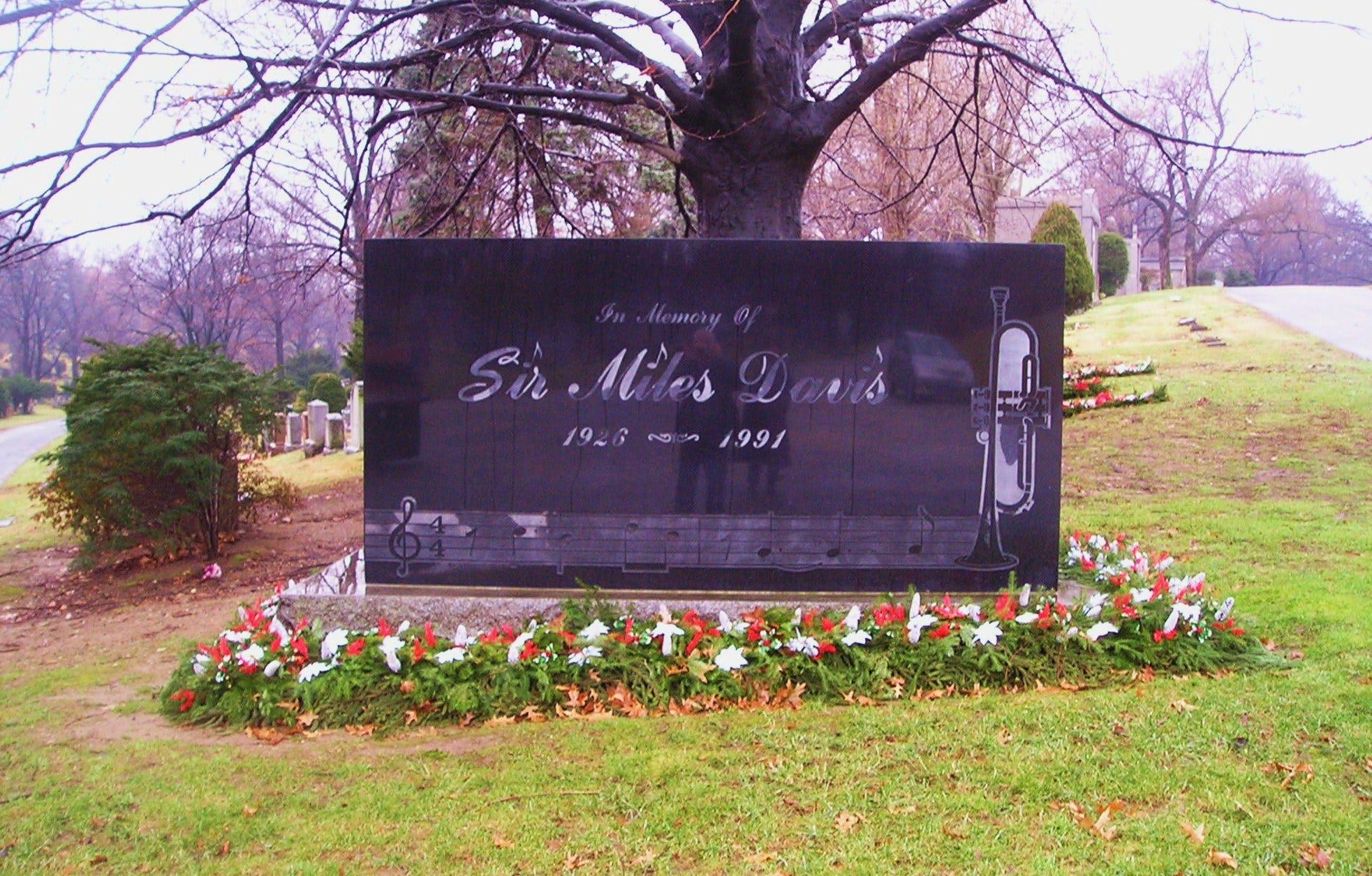
What is strange is not that the credit is contested. Contested credits are ordinary in this music. What is strange is that the argument is not about who sat at the piano. It is about who signed the paperwork. For roughly two decades, from the first bebop sides of the mid-1940s through the hard bop era of the early 1960s, the name on a jazz record’s label and in its copyright file was set by contract more often than by authorship. The composer credit on a bebop standard is often best read not as a musical claim but as a business document.
It is an uncomfortable idea, so let’s be precise about it. It does not mean the famous players were thieves in any simple sense. It means the copyright owners, the labels and their in-house publishing arms, put the most bankable name on the tune because that name was the one under contract, and because the company collected either way. The villain is not any one musician but the structure. The historian Lewis Porter, who has written the most careful English-language accounts of several of these cases, returns to the same point: the companies did it on purpose, and they did it for money.
The economics that made it worth doing
To see why a publisher would bother, look at how little each play was worth and how many plays a standard accumulates. Under the Copyright Act of 1909, the statutory mechanical royalty, the fee owed to the composition’s owner for each record pressed, was fixed at two cents per side. That rate did not move for sixty-nine years; it was still two cents in 1978. Two cents is nothing on one record. But a jazz standard is not one record. “Donna Lee” alone has been recorded several hundred times, and every one of those recordings, plus every reissue and every cover, pays the owner of the copyright. Multiply a trivial per-unit rate across decades of pressings and the value of owning a single durable tune becomes a career’s worth of money.
The men who ran the independent labels understood this better than the musicians did. Herman Lubinsky at Savoy and Bob Weinstock at Prestige each built a publishing arm alongside the label, Savoy feeding Atlantic Music and Prestige feeding Prestige Music Co. The label paid a session fee up front, a fixed sum a young player was glad to take, while the publishing arm kept the copyright that paid out for the next half century. Choosing cash now over royalties later was a rational choice in the moment and a ruinous one over time.
The enforcement math ran the same way. When the alto saxophonist Jackie McLean realized that two tunes from a 1951 Prestige date had gone out under Davis’s name, he consulted a lawyer. The answer, by McLean’s own account, was that whatever he recovered would not cover the cost of recovering it. So he let it go. Fighting was irrational for one man; across every young player who reached the same conclusion, the sums that stayed with the labels were enormous.
What the ledger looks like
Read credits this way and a pattern sorts into three groups. Tunes written by one musician and registered to the bigger star under contract. Tunes where an extra name was added as the price of getting the record made or the song placed. And composers who refused the arrangement and kept their own publishing. Side by side, they read less like a series of individual grievances than like a single business practice with variations.
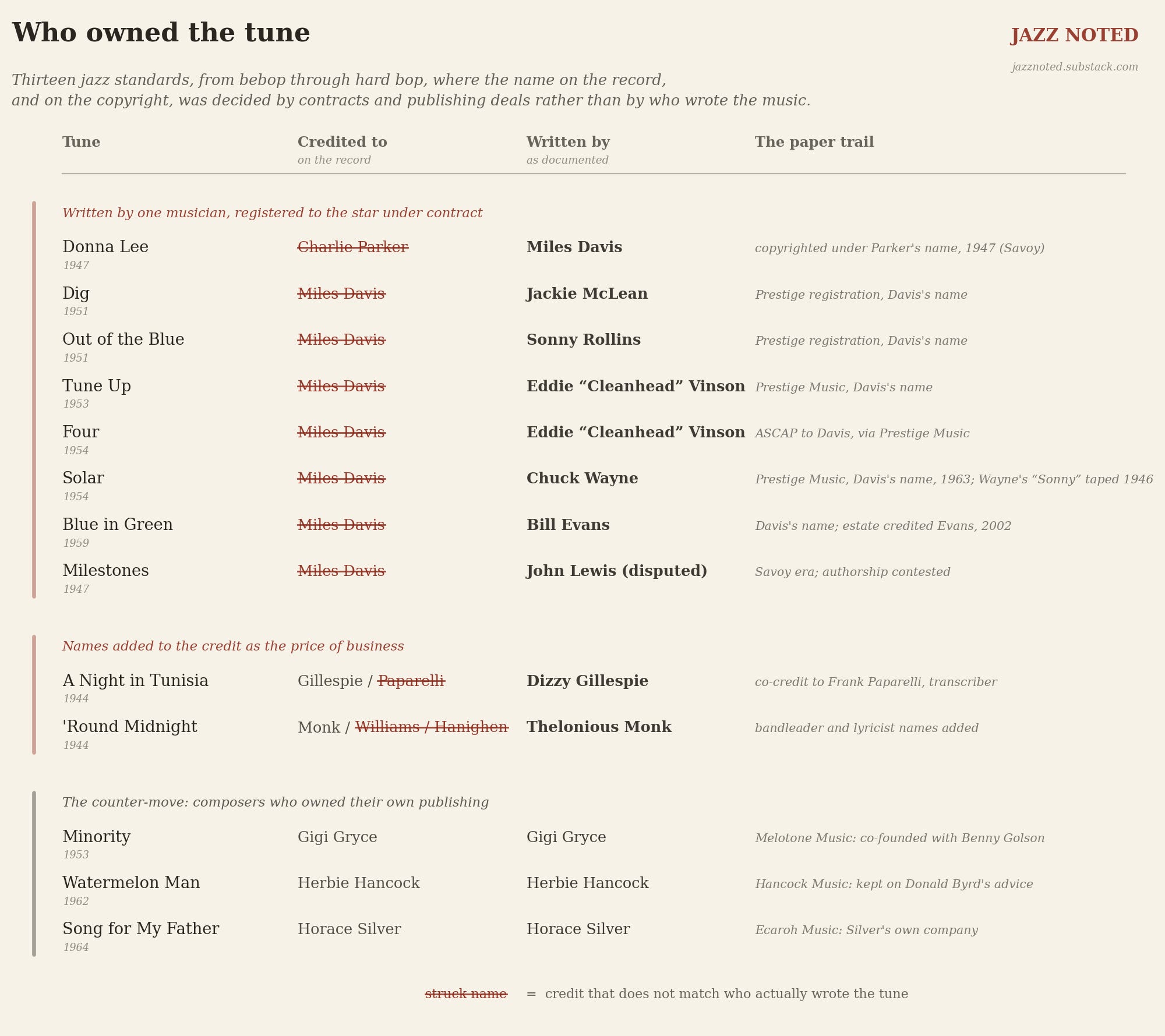
The largest group gathers around Miles Davis, and it cuts in both directions, which is what keeps it honest. Davis is on the ledger as a beneficiary more than once, but the very first entry has him as the victim.
The Davis cases, in both directions
Start with the beneficiary side, because it is the clearest. “Four” and “Tune Up,” drilled into every jazz musician’s memory, first appeared under Davis’s name in 1953 and 1954, published through Prestige Music. Both were written by the blues singer and alto saxophonist Eddie “Cleanhead” Vinson, in whose band a young John Coltrane worked around 1952 and 1953. Vinson said he wrote them and maintained that claim until his death in 1988. The most telling confirmation came from Davis himself. Asked by the writer Eric Nisenson who really wrote them, Davis named Vinson. Asked why, then, his own name was on them, he answered, “Because I wrote them. What difference does it make?” The contradiction is not carelessness. It is a man who understood that on paper, authorship had already been settled by the credit, and that the credit was the only version that paid.
“Dig,” from that 1951 Prestige session, was brought in by Jackie McLean and went out under Davis’s name; this is the case McLean took to the lawyer. The same date produced “Out of the Blue,” which by McLean’s account was Sonny Rollins’s tune and met the same fate. The Rollins attribution rests on that single account, so hold it a notch less firmly, but it belongs to the same session and the same practice.
Then the reversal. “Donna Lee,” recorded in 1947, was Davis’s first composition to be put on record, and it was copyrighted that year under the name of Charlie Parker. Davis, in his autobiography, waved it off as a company mistake. Porter’s correction is the load-bearing insight of this whole story: it was not a mistake. Savoy credited Parker because Parker was the contracted star and the copyright would sit with Savoy’s publishing arm no matter whose name went on top. Max Roach, who was in the room, later confirmed that everyone at the session knew Davis had written it. So the man who benefited from the practice on “Four” was cheated by the identical practice on “Donna Lee.” The system did not care which chair you sat in.
The tape that outranked the registration
The centerpiece is “Solar,” because it is the one case where a government archive contradicts a government registration in black and white.
In 2011 the Library of Congress acquired the papers of the guitarist Chuck Wayne, a bebop-era player who had passed through Woody Herman’s band. Among the manuscripts and photographs was an unpublished ten-inch acetate disc from a 1946 jam session in Oklahoma City. On it, Wayne plays an original built loosely on the changes of “How High the Moon,” a tune he had named “Sonny” for the trumpeter Sonny Berman, audible beside him. The melody is, in the words of the Library’s jazz specialist Larry Appelbaum, who published the find in 2012, “remarkably similar to a song made famous years later by Miles Davis under the title Solar.” The differences are cosmetic. Davis opened the tune on a minor chord where Wayne had used a major one, the kind of one-note change publishers have long used to claim a fresh copyright.
Wayne never registered “Sonny.” Seventeen years after that acetate was cut, on August 8, 1963, Prestige Music Co. registered “Solar” for copyright and named the composer as Miles Davis. The New Grove Dictionary of Jazz had long since recorded Wayne’s version of events, stating flatly that Davis “later appropriated and claimed” the tune under a new title. Wayne told the story for the rest of his life, including a 1996 interview in which he recalled Davis coming to hear the Herman band and asking for the tune. He never filed the paper that would have made his claim collectible. Davis filed his, and Davis got the headstone.
The cut-in
A second mechanism is gentler and just as durable: the added name. On Dizzy Gillespie’s “A Night in Tunisia,” from 1944, the copyright carries Gillespie and Frank Paparelli. Paparelli was a transcriber who, by the standard account, had nothing to do with composing the tune; the credit was compensation for unrelated transcription work, a favor paid in the one currency that keeps paying.
Thelonious Monk’s “’Round Midnight” carries three names: Monk, the bandleader Cootie Williams, who added an eight-bar interlude and whose orchestra recorded it first, and the lyricist Bernie Hanighen, who wrote words to it in 1944. To this day the royalties on one of the most covered ballads in the repertoire are split three ways, two of the shares going to men who did not write the melody. Neither addition was theft in the “Solar” sense. Both show the same fact from another angle: the credit was a negotiable asset, handed out for access, transcription, or a first recording, not a fixed record of who composed what.
The counter-move
The musicians learned. The last group on the ledger answers the first two: composers who stopped signing their copyrights away and started their own publishing companies. Duke Ellington had shown it was possible as early as 1941, when he set up Tempo Music, run largely by his sister Ruth. In the bebop generation the alto saxophonist and arranger Gigi Gryce co-founded Melotone Music with Benny Golson around 1955, one of the first Black musician-owned publishing operations of its kind. It cost him. Accounts of Gryce’s career hold that the industry’s resistance to a Black artist controlling his own rights contributed to his professional marginalization, and he largely left the scene by the early 1960s. Owning the tune turned out to be dangerous precisely because it worked.
The clearest victory belongs to Herbie Hancock. Before a young Hancock signed with Blue Note in 1962, the trumpeter Donald Byrd told him not to let the label take his publishing. When Alfred Lion asked him to write more songs for the album that became Takin’ Off, Hancock kept the copyrights, including “Watermelon Man.” A year later Mongo Santamaria turned “Watermelon Man” into a hit, and the royalties, on a copyright Hancock owned outright, funded his independence. He tells the story in his memoir Possibilities. Horace Silver did the same on his own terms, running everything through Ecaroh Music, his own company, its name simply “Horace” spelled backward. “Song for My Father” is the emblem of it: a standard whose composer also owned it.
What the register can and cannot fix
The copyright register is a public document. Anyone can read who filed what and when, and in the “Solar” case the Library of Congress has published the acetate that predates the filing by seventeen years. So the record is, in a narrow sense, correctable. Estates can be acknowledged, as Evans’s was. Archivists can put a 1946 disc online and let the melody testify for itself.
What the register cannot do is pay the dead on time. The two-cent rate that made these copyrights worth taking ran for decades, and the money moved while the men who wrote the tunes were alive to need it. Vinson kept teaching. McLean let his claim go on a lawyer’s arithmetic. Chuck Wayne carried his acetate to the end without filing the one piece of paper that would have made it count. The tunes are corrected now, or corrected enough. The careers were not. That is the part of the ledger that does not balance, and the reason the story is worth telling in a music that still, rightly, loves the men whose names are on the tombstones.
👏 👏👏 One more brilliant post, Michael ! 👏 👏 👏